React Server Components: The Future of React
Understand React Server Components architecture. Learn how RSC changes React development, benefits, limitations, and implementation patterns.
React Server Components (RSC) represent a fundamental shift in how React applications are built, enabling server-rendered components that never send JavaScript to the client. Introduced as an experimental feature and now production-ready in frameworks like Next.js, RSC enables better performance, reduced bundle sizes, and direct server access from components. This guide explains RSC architecture, benefits, limitations, and practical implementation patterns. Understanding Server Components is crucial for building modern React applications.
📚 Table of Contents
Understanding Server Components
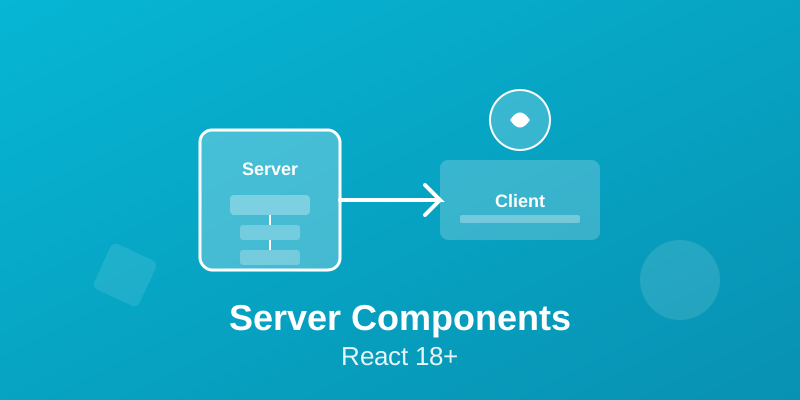
Server Components render exclusively on the server, generating HTML or a special format that React can hydrate efficiently. Unlike Server-Side Rendering (SSR) which sends HTML plus JavaScript for hydration, Server Components don't ship any component code to the client. This dramatically reduces JavaScript bundle size.
Server Components can directly access databases, file systems, and backend services without API routes. They render at request time or build time depending on caching. Client Components (marked with "use client") work as before, containing interactive elements.
The key innovation is seamless composition of Server and Client Components in the same tree, with Server Components as default.
Benefits of Server Components
Server Components provide multiple benefits. Reduced bundle size since component code doesn't ship to client - only HTML/JSX output. Direct backend access from components without API routes simplifies data fetching.
Automatic code splitting where Server Components are split by default. Improved initial page load as less JavaScript downloads. Better SEO since content is available immediately.
Secure server-side operations with sensitive logic never exposed to clients. Streaming support where Server Components can stream HTML progressively. Server Components can use Node.js modules and APIs without worrying about bundle size.
These benefits make applications faster, more secure, and simpler to build.
Server vs Client Components
Choose Server Components by default. Use Client Components when you need interactivity, browser APIs, React hooks like useState or useEffect, event handlers, or lifecycle methods. Server Components can import Client Components but not vice versa - Client Components can't import Server Components directly (but can receive them as children).
Server Components can be async for data fetching. They re-render on navigation or when data changes. Client Components work as traditional React components.
Server Components can't use React hooks or browser APIs. Plan component boundaries carefully - move interactivity to Client Components while keeping server logic in Server Components. This boundary definition is key to effective RSC architecture.
Data Fetching Patterns
Server Components transform data fetching. Fetch data directly in Server Components using async/await without useEffect or state. No loading states needed for initial data since it renders on server.
Use fetch with Next.js caching or access databases directly. Parallel data fetching by making multiple fetch calls - they run concurrently. Waterfall fetching by calling functions that fetch - sometimes intentional for dependent data.
Server Components can use any Node.js data source. For mutations, use Server Actions. Client Components still fetch data via APIs or Server Actions.
This pattern eliminates much of the data fetching boilerplate in traditional React apps. Cache data appropriately using Next.js caching mechanisms.
Composition Patterns
Effective RSC usage requires understanding composition patterns. Server Components can render Client Components directly. Pass Server Components to Client Components as children or props - this allows Client Component wrappers around Server Component content.
Don't pass functions or non-serializable data from Server to Client Components. Share code between Server and Client Components by placing it in separate modules. Use Context in Client Components only - not across Server/Client boundary.
For shared state, lift it to Client Components. Serialize data when passing from Server to Client Components. These patterns enable building complex UIs with optimal performance and interactivity.
Limitations and Challenges
Server Components have limitations. Can't use React hooks, event handlers, browser APIs, or lifecycle methods. Can't share client-side state across Server Components.
Debugging is harder since rendering happens server-side. Need to think carefully about Server/Client boundaries. Some third-party libraries work only in Client Components.
Learning curve for developers used to traditional React. File convention ("use client") feels unusual initially. Mental model shift from client-centric to server-first thinking.
Some patterns require rethinking - data fetching, state management, error handling. Despite limitations, benefits outweigh challenges for most applications. Framework support (Next.js) makes adoption easier.
Migration and Adoption
Migrating to Server Components requires planning. Start with new features or pages before converting existing code. Identify components that can be Server Components - those without interactivity or hooks.
Convert data-fetching components to Server Components, removing useEffect and useState. Mark interactive components with "use client". Test thoroughly - Server Component errors manifest differently than client errors.
Update third-party libraries to RSC-compatible versions where available. Not all apps need Server Components immediately - assess if benefits justify migration effort. New projects should use Server Components from the start.
Frameworks like Next.js 13+ default to Server Components, making adoption natural. Follow framework documentation for best practices.
💡 Key Takeaways
React Server Components represent the future of React development, offering significant performance and developer experience improvements. By rendering on the server and sending minimal JavaScript to clients, RSC enables building faster, more maintainable applications.
Conclusion
React Server Components represent the future of React development, offering significant performance and developer experience improvements. By rendering on the server and sending minimal JavaScript to clients, RSC enables building faster, more maintainable applications. While requiring mental model shifts and having limitations, the benefits are substantial. Frameworks like Next.js make RSC adoption practical today. As the ecosystem matures, tooling improves, and patterns emerge, Server Components will become the default way to build React applications. Start learning RSC now to stay current with React's evolution. The sooner you embrace Server Components, the better positioned you'll be for React's future.