Next.js ISR and SSG: Static Generation Strategies
Master Next.js Static Site Generation and Incremental Static Regeneration. Build fast, SEO-friendly sites that stay up-to-date.
Next.js Static Site Generation (SSG) and Incremental Static Regeneration (ISR) enable building incredibly fast websites that rival static sites while supporting dynamic content. SSG generates HTML at build time for maximum performance, while ISR allows updating static pages after deployment without rebuilding the entire site. This guide explores both strategies in depth, covering implementation, caching strategies, revalidation patterns, and real-world use cases. Understanding these features is essential for building performant Next.js applications that deliver excellent user experience and SEO.
📚 Table of Contents
Static Site Generation Fundamentals
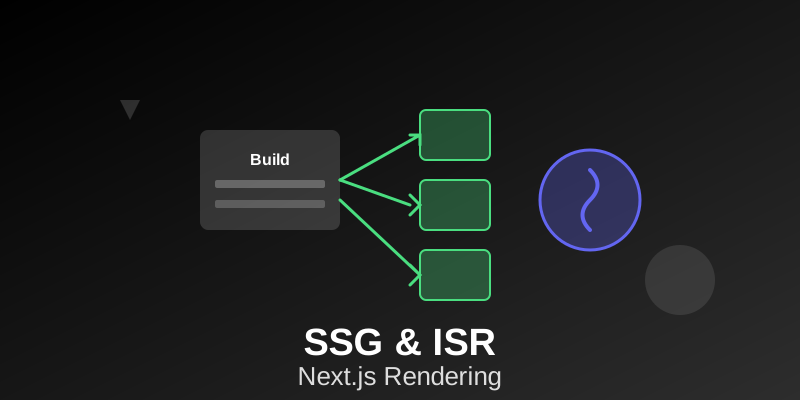
SSG generates HTML for pages at build time rather than request time. Export getStaticProps from a page component to fetch data during build. Next.js calls this function at build time, passes the returned data as props to the page component, and generates HTML.
This HTML is served instantly to users with no server rendering. SSG is perfect for content that doesn't change often - blogs, marketing pages, documentation. For dynamic routes, implement getStaticPaths to specify which paths to generate.
Use fallback: false to only generate specified paths, fallback: true to generate additional paths on-demand, or fallback: "blocking" to server-render on first request then cache. SSG provides the fastest possible page loads and best SEO since content is available immediately.
Incremental Static Regeneration
ISR allows updating static pages after deployment without rebuilding the entire site. Add a revalidate option to getStaticProps to enable ISR. The number specifies seconds after which Next.js attempts to regenerate the page.
When a request comes in after the revalidation period, Next.js serves the stale page while regenerating in the background. The next request gets the fresh page. This stale-while-revalidate pattern provides instant page loads while keeping content fresh.
ISR is perfect for e-commerce product pages, news articles, or any content that changes periodically. Combine ISR with on-demand revalidation using revalidatePath() or revalidateTag() in Server Actions to instantly update pages when content changes. ISR provides static site performance with dynamic content freshness.
getStaticProps and Data Fetching
getStaticProps runs only at build time on the server. It can safely use server-side code, access databases, or call APIs with secret keys. The function must return an object with a props key containing serializable data.
Optionally return revalidate for ISR, notFound: true to show 404, or redirect to redirect to another page. getStaticProps can use any data source - databases, CMS, APIs, or file systems. Use it to fetch data, process it server-side, and pass only necessary data to components.
For multiple data sources, fetch all data in getStaticProps rather than cascading requests. This enables parallel data fetching and optimizes build times. Remember that getStaticProps output is included in the page's JavaScript bundle, so keep returned data minimal.
Dynamic Routes and getStaticPaths
For dynamic routes like /posts/[slug], implement getStaticPaths to tell Next.js which paths to generate. Return an object with paths array containing objects with params. Each params object represents one page to generate.
The fallback option controls behavior for paths not specified: false returns 404, true generates on first request client-side, "blocking" generates on first request server-side. Use fallback: "blocking" for better SEO and UX. For large sites with thousands of pages, generate important pages at build time and use fallback for others.
This optimizes build time while ensuring all pages work. In getStaticPaths, you might fetch all IDs from a database or CMS. For massive datasets, consider generating only popular pages at build time.
On-Demand Revalidation
On-demand revalidation enables instantly updating ISR pages when content changes. Use revalidatePath() in Server Actions or Route Handlers to revalidate specific paths. Call revalidateTag() to revalidate all pages using a specific cache tag.
This is powerful for instant content updates - when an editor publishes new content in a CMS, trigger on-demand revalidation via webhook. Users immediately see updated content without waiting for the revalidation period. Implement secure webhook endpoints that verify requests come from your CMS.
Handle webhook failures gracefully with retries. On-demand revalidation combined with ISR provides the best of both worlds - static performance with instant updates. This pattern enables building large content sites with CDN-level performance and instant publishing.
Caching and CDN Integration
SSG and ISR pages are cached at multiple levels for maximum performance. Next.js caches generated pages, CDNs cache static assets globally, and browsers cache locally. When deploying to Vercel, SSG/ISR pages are automatically distributed to the edge network globally.
For self-hosting, configure CDN to cache static pages. Set appropriate Cache-Control headers for different content types. Use CDN purge APIs for instant cache invalidation when needed.
ISR's stale-while-revalidate pattern works beautifully with CDN caching. For private or user-specific content, use Server Components or client-side fetching instead of SSG. Understand your caching strategy at each level - application, CDN, and browser.
Monitor cache hit rates to ensure effective caching. Proper caching makes sites incredibly fast and reduces server costs.
Best Practices and Pitfalls
Generate only necessary pages at build time - generating thousands of pages increases build time significantly. Use ISR with fallback for large datasets. Keep getStaticProps fast - slow data fetching delays builds.
Implement parallel data fetching when possible. Don't fetch data that changes per-request in getStaticProps - use Server Components or API routes instead. Remember getStaticProps runs at build time - it doesn't have access to request-specific data like cookies or headers.
For user-specific content, fetch client-side or use Server Components. Set appropriate revalidate values - too short and you lose ISR benefits, too long and content gets stale. Monitor revalidation patterns to optimize.
Test locally with next build && next start to verify static generation works correctly. Document which pages use SSG vs ISR vs SSR for team clarity.
💡 Key Takeaways
Next.js SSG and ISR enable building websites that are both incredibly fast and capable of displaying fresh content. SSG provides unmatched performance for content that doesn't change often, while ISR adds the ability to update pages after deployment.
Conclusion
Next.js SSG and ISR enable building websites that are both incredibly fast and capable of displaying fresh content. SSG provides unmatched performance for content that doesn't change often, while ISR adds the ability to update pages after deployment. The combination of these techniques, especially with on-demand revalidation, enables building large content sites with CDN-level performance and instant content updates. Choose SSG for truly static content, ISR for content that changes periodically, and on-demand revalidation for instant updates. Understand your content update patterns and choose the right strategy for each part of your site. With proper implementation, SSG and ISR make Next.js one of the most powerful frameworks for building performant, SEO-friendly websites.