NestJS Microservices: Building Distributed Systems
Build scalable microservices with NestJS. Learn about message patterns, transport layers, and inter-service communication strategies.
Microservices architecture has become the standard for building large-scale, maintainable applications. NestJS provides first-class support for microservices with multiple transport layers, making it easy to build distributed systems. This guide covers everything from basic microservice setup to advanced patterns like event-driven architecture, handling failures, and monitoring distributed systems. Whether you're breaking down a monolith or building a new microservices-based application, understanding NestJS microservices capabilities will help you create scalable, resilient systems.
📚 Table of Contents
Microservices Architecture Overview
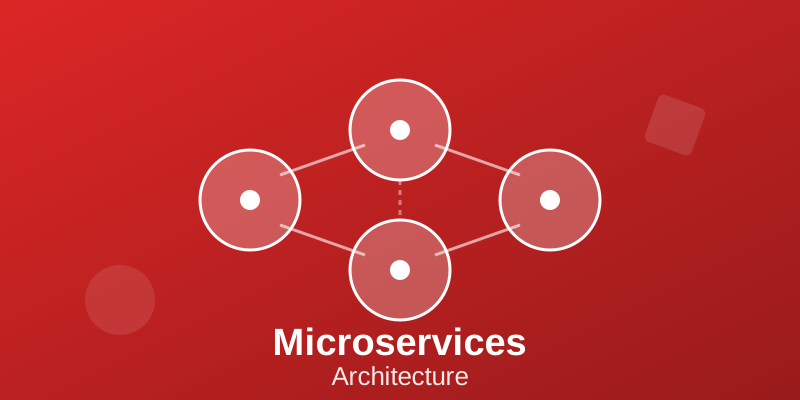
Microservices architecture breaks applications into small, independent services that communicate over the network. Each service owns its data, can be deployed independently, and is built around business capabilities. NestJS supports multiple transport layers including TCP, Redis, NATS, RabbitMQ, Kafka, gRPC, and MQTT.
Choose transports based on your requirements: TCP for simple request-response, Redis for pub/sub patterns, Kafka for event streaming, and gRPC for high-performance RPC. Microservices enable independent scaling, technology flexibility, and fault isolation. However, they add complexity: distributed data management, network latency, and debugging challenges.
Start with a monolith and split into microservices when you have clear domain boundaries and scaling needs.
Setting Up NestJS Microservices
Create microservices in NestJS using the createMicroservice() method instead of create(). Configure the transport layer and options specific to that transport. Services can act as both microservice and HTTP server simultaneously - this is useful for health checks and admin endpoints.
Use @MessagePattern() decorator for request-response communication and @EventPattern() for event-driven, one-way messaging. Message patterns are strings or objects that identify message types. Controllers in microservices handle messages instead of HTTP requests.
Implement proper error handling and validation for messages. Use DTOs (Data Transfer Objects) to define message structure. Deploy microservices as separate Node.js processes or containers.
Configure service discovery for production environments.
Inter-Service Communication
NestJS provides ClientProxy for sending messages to microservices. Inject ClientProxy using @Client() decorator or through dependency injection with ClientsModule. Use send() for request-response patterns that wait for responses, and emit() for fire-and-forget event patterns.
Implement timeouts for requests to prevent hanging. Use RxJS operators to handle responses - microservice communication in NestJS returns Observables. Implement retry logic for failed requests.
For complex workflows spanning multiple services, consider saga patterns or orchestration. Use correlation IDs to track requests across services. Implement circuit breakers to prevent cascading failures.
Cache responses when appropriate to reduce inter-service traffic. Monitor request latency and error rates between services.
Event-Driven Architecture
Event-driven architecture enables loose coupling between services. Services emit events when state changes, and interested services subscribe to those events. Use @EventPattern() to handle events in NestJS.
Events should be immutable and include all necessary data. Design events around business domain events, not technical implementation details. Use event sourcing to maintain event history for auditing or state reconstruction.
Implement idempotent event handlers since events may be delivered multiple times. Order events when sequence matters - use Kafka partitions or message groups in SQS. Consider using dead letter queues for failed event processing.
Event-driven systems scale well but are harder to reason about than request-response. Document event schemas and maintain backward compatibility.
Data Management in Microservices
Each microservice should own its database - never share databases between services. This enables independent scaling and deployment. Use API calls or events to access data from other services.
Implement the Database per Service pattern. For queries needing data from multiple services, use the API Composition pattern or CQRS (Command Query Responsibility Segregation). Maintain data consistency using sagas - coordinated sequences of local transactions.
Implement compensating transactions for rollbacks. Use eventual consistency where immediate consistency isn't required. Consider event sourcing for complex domains.
Replicate data when needed for performance - denormalization is acceptable in microservices. Handle distributed transactions carefully - they're complex and fragile. Most systems can use eventual consistency with proper design.
Service Discovery and Load Balancing
In production, microservices need to discover each other dynamically. Use service discovery solutions like Consul, etcd, or Kubernetes services. Implement health checks that service discovery systems can poll.
Use client-side or server-side load balancing to distribute requests. API Gateway pattern provides a single entry point for clients, routing requests to appropriate microservices. Consider using service mesh like Istio for advanced traffic management, security, and observability.
Implement graceful shutdown to finish processing requests before terminating. Use DNS for simple service discovery in Kubernetes. Configure appropriate timeouts and retries.
Monitor service health continuously. Design services to handle partial failures gracefully.
Monitoring and Debugging
Distributed systems require sophisticated monitoring. Implement distributed tracing using tools like Jaeger or Zipkin to track requests across services. Use correlation IDs to link logs across services.
Implement structured logging with consistent formats. Collect metrics for request rates, error rates, latency, and saturation (the four golden signals). Use APM (Application Performance Monitoring) tools like New Relic or Datadog.
Implement health check endpoints for each service. Set up alerting for critical issues. Use log aggregation tools like ELK stack or CloudWatch.
Debug issues by analyzing traces and logs together. Implement proper error handling and reporting. Test microservices with chaos engineering to ensure resilience.
Monitor database connection pools and external service calls. Regular load testing helps identify bottlenecks.
💡 Key Takeaways
Building microservices with NestJS provides the tools and patterns needed for successful distributed systems. The framework's transport-agnostic approach and first-class TypeScript support make microservices development more accessible.
Conclusion
Building microservices with NestJS provides the tools and patterns needed for successful distributed systems. The framework's transport-agnostic approach and first-class TypeScript support make microservices development more accessible. However, microservices architecture isn't a silver bullet - it trades monolith complexity for distributed system complexity. Choose microservices when you have clear service boundaries, need independent scaling, or want team autonomy. Start simple, monitor everything, and evolve your architecture as requirements change. NestJS makes the technical implementation straightforward, but success requires careful attention to service boundaries, data management, and operational concerns. With proper planning and implementation, microservices enable building highly scalable, resilient applications that can evolve independently.