GraphQL Federation: Building a Unified API Gateway
Master GraphQL Federation to combine multiple GraphQL services into a single unified API. Learn about Apollo Federation, schema composition, and microservices integration.
GraphQL Federation enables building a single, unified GraphQL API from multiple underlying GraphQL services. This approach combines the benefits of microservices architecture with GraphQL's powerful query capabilities, allowing teams to work independently while presenting a cohesive API to clients. Apollo Federation has become the de facto standard for federated GraphQL, providing tools and patterns for composing schemas, referencing entities across services, and managing the gateway layer. This guide covers everything from basic federation concepts to advanced patterns for building scalable, maintainable federated graphs.
📚 Table of Contents
Understanding Federation Concepts
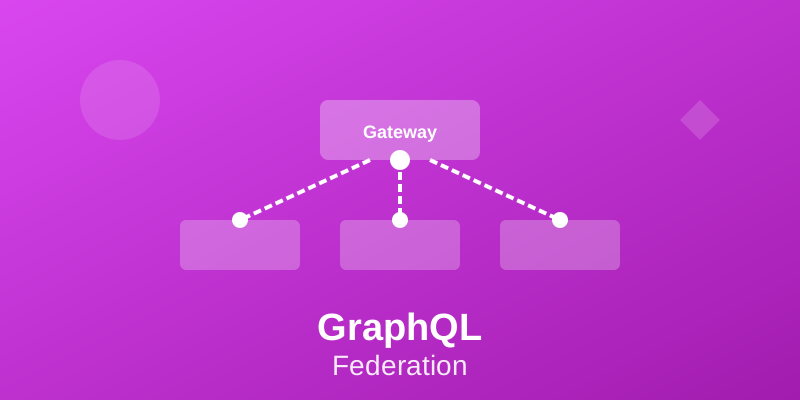
GraphQL Federation allows multiple GraphQL services (subgraphs) to be composed into a single supergraph accessed through a gateway. Each subgraph owns part of the overall schema and can reference entities defined in other subgraphs. The @key directive marks entities that can be referenced across subgraphs.
Entities are types with a globally unique identifier that can be extended by multiple subgraphs. The gateway handles query planning - determining which subgraphs to call and in what order to fulfill a query. Federation enables independent deployment of subgraphs while maintaining a single GraphQL endpoint for clients.
This architectural pattern is ideal for organizations with multiple teams building different parts of a larger system. Understanding these concepts is fundamental before implementing federation.
Setting Up Apollo Federation
Start by creating subgraph services using Apollo Server with @apollo/subgraph package. Define your schema with @key directive on entities you want to share. Implement reference resolvers to fetch entities by their keys - this tells the gateway how to resolve entity references.
Set up Apollo Gateway as a separate service that pulls schema definitions from all subgraphs. In production, use managed federation with Apollo Studio for schema versioning and composition checking. Configure the gateway with the subgraph URLs or use Apollo Studio for automatic subgraph discovery.
The gateway automatically handles query planning and execution across subgraphs. Implement health checks for both gateway and subgraphs. Use supergraph schema composition in CI/CD to catch schema composition errors early.
Entity Design and Schema Composition
Design entities carefully - they're the foundation of federation. An entity should have a stable unique identifier and be owned by one primary subgraph. Other subgraphs can extend entities to add fields.
Use @key directive to specify how entities are uniquely identified. Multiple @key directives enable different ways to identify the same entity. Design boundaries between subgraphs based on domain models, not technical layers.
Avoid chatty patterns where resolving one field requires multiple subgraph calls. Use value types (non-entity types) for data that doesn't need cross-subgraph references. Consider future extensibility when designing entity keys.
Document entity ownership clearly. Validate composed schemas in CI/CD to catch composition errors before deployment.
Performance and Query Planning
The gateway executes query plans by calling multiple subgraphs and combining results. Understand query planning to optimize performance. Use @provides directive to inline fields from other subgraphs, reducing separate calls.
The @requires directive specifies fields needed from other subgraphs to resolve a field. Implement DataLoader in each subgraph to batch and cache requests. Monitor query execution time and identify slow subgraphs.
Consider adding response caching at the gateway level for frequently requested data. Use persisted queries to reduce payload size and improve security. Profile queries with Apollo Studio to understand execution patterns.
Implement field-level caching where appropriate. Design schemas to minimize cross-subgraph dependencies. Balance between granular subgraphs and query performance.
Error Handling and Resilience
Federation adds complexity to error handling since failures can occur in any subgraph. Implement proper error handling in subgraphs - return meaningful error messages and codes. The gateway aggregates errors from subgraphs in the response.
Configure the gateway to handle subgraph failures gracefully - decide whether to fail the entire query or return partial data. Implement circuit breakers to prevent cascading failures. Use health checks to detect unhealthy subgraphs.
Configure appropriate timeouts for subgraph calls. Implement retry logic for transient failures. Monitor error rates per subgraph.
Use distributed tracing to understand request flow across subgraphs. Design schemas to avoid hard dependencies - allow queries to succeed even if some subgraphs are unavailable. Document expected error scenarios and handling strategies.
Authentication and Authorization
Handle authentication at the gateway level - verify tokens and user identity before forwarding requests to subgraphs. Pass authenticated user context to subgraphs through headers. Implement authorization in subgraphs since they own the data and understand domain-specific permission rules.
Use directives like @authenticated or custom directives to enforce auth requirements at the schema level. Consider implementing role-based access control (RBAC) or attribute-based access control (ABAC). Pass minimal necessary user information to subgraphs.
Don't expose sensitive authentication details to subgraphs. Implement field-level authorization in subgraphs for fine-grained control. Use Apollo Studio for schema-level auth policies.
Test authorization thoroughly - both at field level and entity level. Monitor unauthorized access attempts.
Deployment and Monitoring
Deploy subgraphs independently - this is a key benefit of federation. Use managed federation with Apollo Studio for automatic schema composition and validation. Implement schema checks in CI/CD to catch breaking changes before deployment.
Use blue-green or canary deployments for subgraphs. Monitor each subgraph independently and the gateway as a whole. Track query execution time, error rates, and cache hit rates.
Use distributed tracing to understand performance across the federation. Implement logging with correlation IDs to track requests across services. Set up alerts for subgraph health and schema composition failures.
Use Apollo Studio for query analytics and schema usage tracking. Version your subgraph schemas and maintain changelog. Document deployment procedures and rollback strategies.
Regularly review and optimize slow queries.
💡 Key Takeaways
GraphQL Federation enables building scalable, maintainable GraphQL APIs in microservices environments. By allowing teams to work independently on subgraphs while presenting a unified API, federation combines flexibility with consistency.
Conclusion
GraphQL Federation enables building scalable, maintainable GraphQL APIs in microservices environments. By allowing teams to work independently on subgraphs while presenting a unified API, federation combines flexibility with consistency. Apollo Federation provides mature tooling for implementing federated graphs, from schema composition to query planning and monitoring. Success with federation requires careful entity design, performance optimization, and robust error handling. While federation adds complexity compared to monolithic GraphQL, the benefits of team independence, deployment flexibility, and schema evolution make it worthwhile for medium to large organizations. Start simple with a few subgraphs, establish patterns and conventions, and gradually expand your federated graph as your architecture evolves.