AWS S3 and CloudFront: Scalable File Storage and CDN
Build scalable file storage and delivery with AWS S3 and CloudFront. Learn about storage classes, CDN optimization, and security best practices.
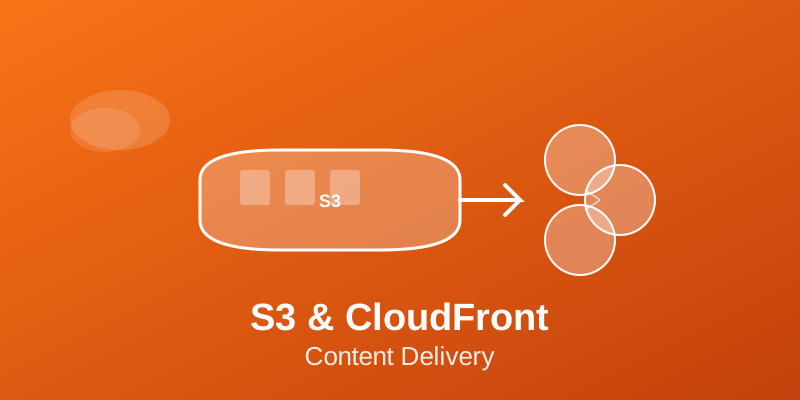
Amazon S3 and CloudFront form the backbone of scalable file storage and content delivery for millions of applications. S3 provides durable, highly available object storage, while CloudFront delivers content globally with low latency through its CDN network. This comprehensive guide covers S3 storage classes, bucket configuration, CloudFront distribution setup, caching strategies, security, and cost optimization. Understanding these services is essential for building modern web applications that handle user uploads, serve static assets, and deliver content globally.
📚 Table of Contents
S3 Storage Classes and Lifecycle Policies
S3 offers multiple storage classes for different use cases. S3 Standard provides high durability and availability for frequently accessed data. S3 Intelligent-Tiering automatically moves objects between access tiers based on usage patterns.
S3 Standard-IA (Infrequent Access) reduces costs for infrequently accessed data. S3 One Zone-IA is cheaper but stores data in a single availability zone. S3 Glacier and Glacier Deep Archive provide ultra-low-cost archival storage with retrieval times from minutes to hours.
Use lifecycle policies to automatically transition objects between storage classes based on age or access patterns. This significantly reduces storage costs for data that becomes less frequently accessed over time. Design lifecycle policies based on your data access patterns and compliance requirements.
S3 Security and Access Control
Secure S3 buckets using bucket policies, IAM policies, and Access Control Lists (ACLs). Block public access by default - enable public access only when necessary and as narrowly scoped as possible. Use bucket policies for resource-based permissions and IAM policies for identity-based permissions.
Implement least privilege principle. Enable server-side encryption (SSE-S3, SSE-KMS, or SSE-C) for data at rest. Use HTTPS for data in transit.
Enable versioning to protect against accidental deletions and overwrites. Use MFA Delete for critical buckets. Implement bucket logging for auditing access.
Use S3 Object Lock for compliance requirements. Pre-signed URLs provide temporary, secure access to private objects. Always validate user uploads to prevent security issues.
CloudFront Distribution Setup
CloudFront is AWS's global CDN service delivering content with low latency. Create distributions pointing to S3 buckets (origins). Configure cache behaviors for different URL patterns.
Set appropriate TTLs (Time To Live) for different content types - long TTLs for static assets, shorter for dynamic content. Use Origin Access Identity (OAI) to restrict S3 access to CloudFront only. Enable HTTPS with ACM certificates for custom domains.
Configure geographic restrictions if needed. Use Lambda@Edge or CloudFront Functions for edge computing. Enable logging to analyze traffic patterns.
CloudFront integrates with AWS WAF for security. Price Class determines which edge locations are used, affecting cost and latency.
Caching Strategies
Effective caching is crucial for performance and cost optimization. Set Cache-Control headers on S3 objects to control CDN and browser caching. Use versioned URLs or query strings for cache busting when content changes.
Configure CloudFront to respect or override origin cache headers. Use multiple cache behaviors for different content types - long caching for immutable assets, shorter for frequently updated content. Implement cache invalidations to immediately update changed content, but use them sparingly as they cost money.
Design URLs to maximize cacheability - keep session data out of URLs. Use cookies sparingly as they affect caching. Monitor cache hit ratios and adjust strategies accordingly.
Proper caching dramatically reduces costs and improves performance.
File Upload Strategies
For file uploads, use pre-signed POST URLs to allow clients to upload directly to S3, bypassing your application servers. Generate pre-signed URLs server-side with limited validity period and size constraints. This scales better and reduces server load.
For large files, use multipart upload to improve reliability and enable parallel uploads. Implement upload progress tracking. Validate file types and sizes before generating pre-signed URLs.
Use CORS configuration on S3 to allow browser uploads. After upload, trigger Lambda functions via S3 events for processing - generate thumbnails, scan for viruses, extract metadata. Store file references in your database, not actual files.
Implement proper error handling for failed uploads.
Image Optimization and Transformation
Serve optimized images to improve performance. Use Lambda@Edge or CloudFront Functions to resize images on-demand. Alternatively, process images on upload using Lambda triggers.
Implement responsive images serving different sizes based on device. Use modern formats like WebP with fallbacks. Set appropriate compression levels balancing quality and size.
Cache transformed images at CDN edge. Consider using services like AWS Lambda with Sharp library for image processing. Implement lazy loading on the client.
Serve images through CloudFront with long cache times. Use CloudFront signed URLs for protected images. Monitor image delivery performance and costs.
Cost Optimization
S3 and CloudFront costs add up quickly without optimization. Use appropriate storage classes - don't use Standard for infrequently accessed data. Implement lifecycle policies to transition or delete old data.
Optimize CloudFront usage by increasing cache TTLs and hit ratios. Use CloudFront compression for text files. Delete incomplete multipart uploads with lifecycle rules.
Monitor data transfer costs - CloudFront to internet is cheaper than S3 direct. Use S3 Intelligent-Tiering for unknown access patterns. Implement request pricing optimization - fewer, larger objects are cheaper than many small ones.
Enable S3 Transfer Acceleration only when needed. Use CloudWatch metrics and Cost Explorer to identify expensive operations. Regular cost reviews help optimize spending.
💡 Key Takeaways
AWS S3 and CloudFront provide powerful, scalable solutions for file storage and content delivery. S3's durability and storage class options handle everything from frequently accessed data to long-term archives.
Conclusion
AWS S3 and CloudFront provide powerful, scalable solutions for file storage and content delivery. S3's durability and storage class options handle everything from frequently accessed data to long-term archives. CloudFront ensures fast, global content delivery with edge caching. Success requires understanding security best practices, implementing effective caching strategies, and optimizing costs. Start with secure defaults, use CDN caching effectively, and monitor both performance and costs continuously. These services scale to any size while remaining cost-effective when properly configured. Master S3 and CloudFront to build applications that deliver excellent user experience worldwide.